
Testing is everywhere in SEO. We test titles, links, content formats, templates, and now AI-generated changes.
Running a test and learning something from it are two different things. You can change a page, watch a move, and still have almost no evidence that your change caused it. You can also see no movement. Wrongly decide the change did nothing.
Good SEO experiments borrow a habit from science: design the test so it’s harder to fool yourself. That takes more than a testing tool or a tidy before-and-after chart. It takes a question, a clear standard of evidence, a test that can produce it, and a willingness to accept an answer you didn’t expect.
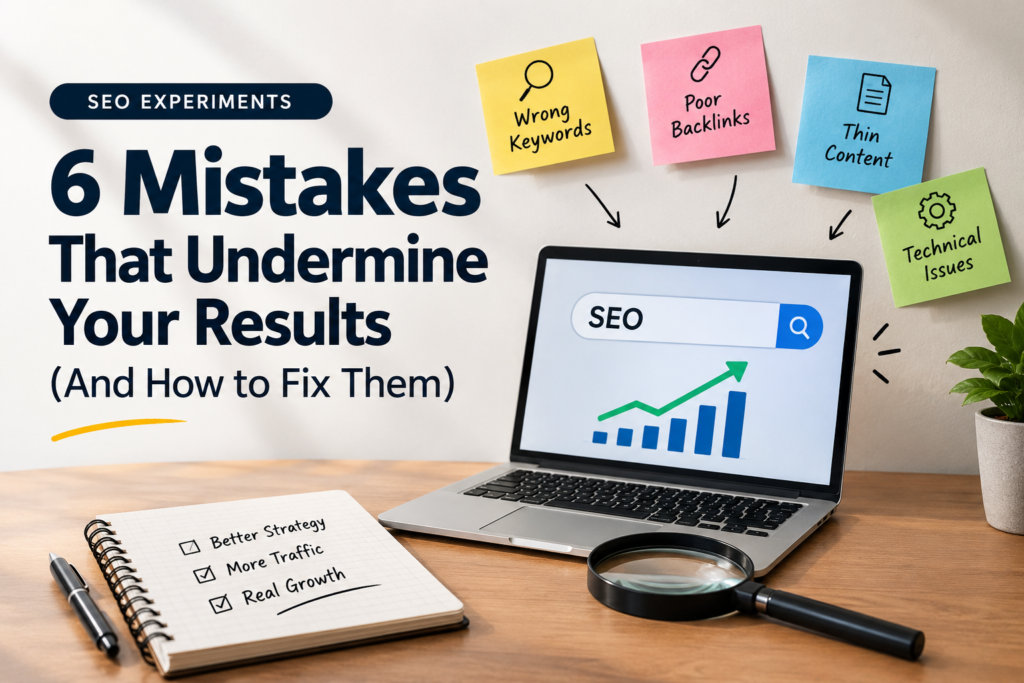
Most SEO testing mistakes happen when you skip one of those steps. Here are six common mistakes and how to avoid each.
1. Starting Without a Falsifiable Hypothesis-SEO experiments
Research starts with a question, not a hypothesis. Ask what the business genuinely doesn’t know and needs to learn. Why is traffic down on product pages since last quarter? Which initiatives are most likely to move the needle?
Then turn that question into a hypothesis that can be proven wrong.
“Improving page titles will improve SEO performance” fails that test. What counts as “improving”? What is “performance”? What result would show you were wrong?
A stronger version looks like this (an example):
Adding the country name to the titles of 700 pages will increase clicks by at least 10% over four weeks compared with the four weeks before the change.
Now there’s a prediction. A 12% gain supports it. A 9% gain falls short. Before you launch, ask: what result would prove me wrong? If nothing could, you aren’t testing anything.
2. Ignoring Confounding Variables and Skipping the Control Group-SEO Experiments
Seeing a change isn’t enough. You need confidence about what caused it.
Websites aren’t labs. While you test, other things may be happening:SEO experiments
- A product release affects the site.
- Marketing launches a campaign.
- Search demand shifts with the season.
- Google rolls out an update.
- Developers ship changes to the same pages.
Researchers call these alternative explanations confounding variables. An illustration: if you compare AI-written pages with human-written pages but the two sets also differ in topic, length, and brand familiarity, you can’t say the writing source caused the difference.
The same logic applies to SEO. Imagine a title change on 500 category pages that appears to lift clicks by 12% in four weeks. Without a control group of untouched pages, you can’t tell whether the titles worked or demand simply rose that month.
Ask yourself:
- Do I have a control group?
- Are the control and test pages truly comparable in intent, template, and traffic history?
- What else changed during the test?
You can’t freeze the rest of the business. You can keep a shared change log across SEO, engineering, product, and marketing. It makes analysis far easier.
3. Deciding What Success Looks Like After Seeing the Results-SEO experiments
There’s an SEO joke: if traffic goes up, it’s your work; if it goes down, it’s a Google update. That’s confirmation bias at work.
If you track metrics and keep the question flexible, something will eventually look positive:
- “Traffic didn’t move, but impressions did.”
- “Impressions are down, but CTR is up.”
- “Average position dropped, but we gained six new keywords.”
Researchers guard against this with preregistration: writing down what they’ll test and how before they see data. You don’t need a registry. Just agree on these before launch:
1.What is the primary metric?
2.What is the comparison group?
3.What is the test period?
What result counts as evidence for or against the hypothesis?
Treat your hypothesis as something to test, not something to defend. Otherwise, you’ll extend the test “for one week” when results disappoint and quietly forget the failures.
4. Drawing Conclusions Your Test Can’t Support-SEO experiments
SEO teams want an answer: it worked, or it didn’t. But a test has at least three possible outcomes:
| Outcome | What it means |
| Evidence of an effect | The data supports your prediction |
| Evidence against an effect | The data contradicts your prediction |
| Not enough evidence | The test couldn’t tell either way |
The third outcome is the one people overlook. If the test is too short, the sample is small, or the data is too noisy, you may simply have missed a real effect. Absence of evidence isn’t evidence of absence.
Time matters too. Pages need to be crawled and reindexed; search engines need time to respond, and behavior changes across days, weeks, and seasons. A tidy seven-day sprint doesn’t guarantee seven days of exposure.
Google’s own testing guidance notes that the time required for a test varies with factors like conversion rates and traffic, and a good testing tool will tell you when you’ve gathered enough data to draw a reliable conclusion. More data won’t rescue a poorly designed test, but it gives a well-designed one a fair chance.
5. Treating Every Test as an Event-SEO experiments
One experiment tells you what happened on one set of pages on one site in one period. It doesn’t prove “Google prefers this “. It shouldn’t become a rule you apply to every market and page type.
Confidence grows when results replicate, and related tests point the way. That’s why an experiment log pays off. For every test, including failed and inconclusive ones, record:
- The question and hypothesis
- The change (treatment) and the pages affected
- Dates and relevant context
- The result and your interpretation
- Limitations
- The decision you made next
Twenty documented tests tell you something real about your site, audience, and markets. One test only gives you a result.
6. Testing for Testing’s Sake-SEO experiments
Experiments exist to reduce uncertainty so you can act. Before you start, finish this sentence: “Depending on what we find, we will…” Scale it? Revert it? Change direction? Do nothing?
Also, separate two questions:
- Can we reasonably believe there’s an effect?
- Is the effect big enough to matter?
Conclusion
SEO experiments are essential for improving website performance, increasing organic traffic, and achieving better search engine rankings. By avoiding common mistakes such as testing too many changes at once, ignoring data, and ending experiments too early, you can make smarter, data-driven decisions that deliver long-term results.
Whether you are a small business owner or an entrepreneur, implementing the right SEO strategies can help you attract more potential customers and grow your online presence. If you are looking for the best digital marketer in Pathanamthitta, I can help you improve your website’s SEO, increase Google visibility, and generate quality leads through effective digital marketing strategies.
Ready to grow your business online? Invest in the right SEO experiments and take the next step toward achieving your digital marketing goals.